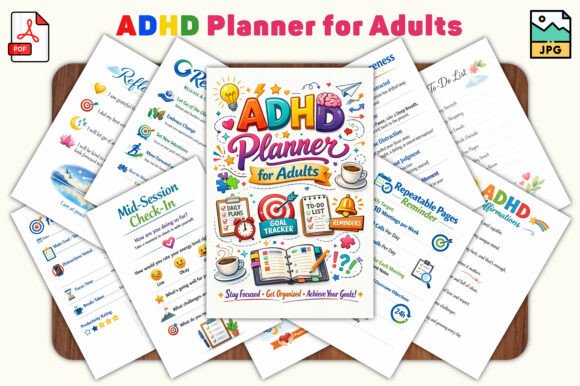
ADHD Planner for Adults: Gentle Structure for Focus
Traditional productivity systems often feel like a test you are destined to fail. They demand rigid consistency, perfect execution, and unwavering motivation—qualities that can be elusive when navigating an ADHD brain. The ADHD Planner for Adults offers a different path entirely. It is not designed to force you into a mold that does not fit your neurology but rather to provide a scaffold that supports how your mind actually works. This approach shifts the focus from "doing more" to managing tasks, time, energy, and emotions in a way that feels realistic, flexible, and compassionate.
For professionals, creators, and entrepreneurs aged 20 to 50, the stakes of disorganization are high. A missed deadline can impact revenue; a forgotten meeting can damage professional relationships; and chronic overwhelm can lead to burnout. However, the solution isn't to work harder or try to emulate neurotypical workflows. Instead, it requires tools that acknowledge time blindness, emotional regulation challenges, and the need for variety. This planner addresses those specific hurdles by removing the pressure of perfectionism and replacing it with judgment-free planning.
Bridging the Gap Between Intention and Action
One of the most significant barriers for adults with ADHD is the gap between knowing what needs to be done and actually starting. This phenomenon is often linked to executive dysfunction and task paralysis. The ADHD Planner for Adults tackles this by utilizing minimal layouts that reduce visual clutter. When a page is overwhelming with too many boxes, lines, and complex instructions, the brain may resist engaging with it at all.
By keeping the design clean and simple, the planner lowers the barrier to entry. You do not need to spend twenty minutes figuring out how to fill out the schedule before you can begin working. Instead, the structure invites immediate engagement. For example, a freelancer might use the daily focus priority section to identify just one critical task for the morning. By narrowing the scope, the planner helps bypass the anxiety of a long, unmanageable to-do list and encourages a single step forward.
Combating Time Blindness with Visual Anchors
Time blindness is a hallmark experience where the passage of time feels abstract or invisible. Many adults struggle to estimate how long a task will take or lose track of hours while hyperfocused on a project. The ADHD Planner for Adults includes dedicated pages to support this specific challenge. These sections act as external anchors, helping to visualize the day's flow without demanding a minute-by-minute schedule that is prone to collapse at the first interruption.
Consider a marketing manager who tends to underestimate the time required for client revisions. With standard planners, they might block out thirty minutes, only to realize two hours later they are still stuck on the same email. The gentle structure of this planner allows for buffer zones and realistic time blocking. It encourages the user to plan based on energy levels rather than arbitrary clock times. If the morning energy is low, the planner supports shifting deep work to the afternoon. This flexibility prevents the frustration of a broken schedule and keeps the user moving toward their goals without the guilt of a missed slot.
Navigating Energy and Emotional Fluctuations
Productivity is not linear, especially for those with ADHD. There are days when focus is sharp and creative ideas flow effortlessly, and there are days when simply getting out of bed feels like a monumental achievement. Traditional planners rarely account for these fluctuations, often labeling off-days as failures. In contrast, the ADHD Planner for Adults incorporates energy mood check-ins and self-care recovery planning.
This feature transforms the planning process from a performance metric into a tool for self-awareness. By tracking energy levels alongside tasks, users can identify patterns. Perhaps they notice that deep-focus sessions yield better results on Tuesdays and Thursdays, while Mondays are better suited for administrative tasks. Recognizing these cycles allows for strategic planning that aligns work with natural biological rhythms.
Furthermore, the inclusion of distraction awareness pages removes the stigma of losing focus. Instead of marking a skipped item as a failure, the user can note what distracted them. Was it an urgent notification? A sudden burst of inspiration for a side project? Or perhaps fatigue? Analyzing these distractions without judgment provides valuable data for future planning. It turns a moment of lost focus into a learning opportunity, strengthening the ability to manage attention over time.
Gentle Habit Building Without the Pressure
p>Habit formation is notoriously difficult for the ADHD brain because dopamine rewards are inconsistent. The ADHD Planner for Adults addresses this through gentle habit-building pages that avoid the punitive nature of "streak" counters. Many apps and planners punish a user for missing a single day, which can trigger a cycle of shame and abandonment of the habit entirely.
This planner operates on a philosophy of progress, not perfection. It encourages users to celebrate small wins and understand that skipping a day is part of the human experience, not a character flaw. For a hobbyist or a small business owner trying to build a consistent content creation routine, this approach is vital. It allows for recovery periods without derailing long-term momentum. The goal is to create a sustainable rhythm that can withstand the inevitable ups and downs of life.
Who Benefits Most from This Approach?
While anyone seeking organization can benefit from a structured tool, the ADHD Planner for Adults is specifically tailored for individuals who have found traditional methods ineffective. This includes professionals in fast-paced environments, such as marketers and educators, who must juggle multiple projects simultaneously. It is equally valuable for entrepreneurs and freelancers who lack external accountability and must rely on internal discipline.
Creatives and bloggers often struggle with the administrative side of their work, letting deadlines slip while they chase inspiration. The planner's focus session logs help bridge this gap, providing a dedicated space to log deep-work activities and separate creative bursts from logistical tasks. Similarly, consumers and parents managing complex household schedules can find relief in the simplified decision-making process offered by the layout.
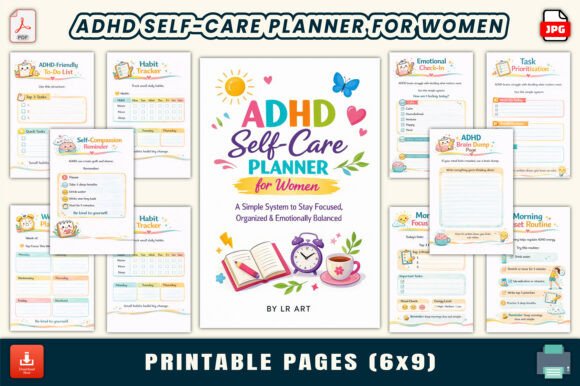
The 6 × 9 inch size makes it portable enough for coffee shops, offices, or classrooms, while the digital formats (PDF and JPG) allow for integration into tablet-based workflows. Whether used as a printable journal or a digital annotation tool, the versatility ensures it fits into various lifestyles. The minimal style ensures it remains a supportive companion rather than another source of stress.
Practical Limitations and Fit Considerations
It is important to recognize that no tool is a magic cure. The ADHD Planner for Adults is a framework, not a fix for underlying neurological conditions. It works best when used as part of a broader strategy that may include therapy, medication, or coaching. Users should view it as a practice ground for developing new habits rather than a guarantee of immediate perfection.
Additionally, while the planner is designed for flexibility, some users accustomed to highly detailed, color-coded systems might initially find the minimalist approach too sparse. It requires a shift in mindset from "filling every box" to "capturing what matters." For those who prefer granular control, the planner offers a foundation that can be customized, but its core strength lies in its simplicity. Users should compare options if they require complex project management features beyond daily focus and energy tracking.
Ultimately, the value of this planner lies in its ability to reduce the cognitive load of planning itself. By offering a judgment-free zone for tracking progress, managing time blindness, and honoring emotional needs, it empowers adults to reclaim their productivity. It moves the conversation from "why can't I stick to my plans?" to "how can I design a plan that works for me?"
Whether you are a publisher looking to streamline your workflow, a blogger aiming to maintain consistency, or a professional striving for better work-life balance, the ADHD Planner for Adults provides the gentle structure necessary to move forward. It acknowledges that real-life productivity is messy, non-linear, and deeply personal. By embracing this reality, users can build a sustainable path toward their goals, one compassionate step at a time.