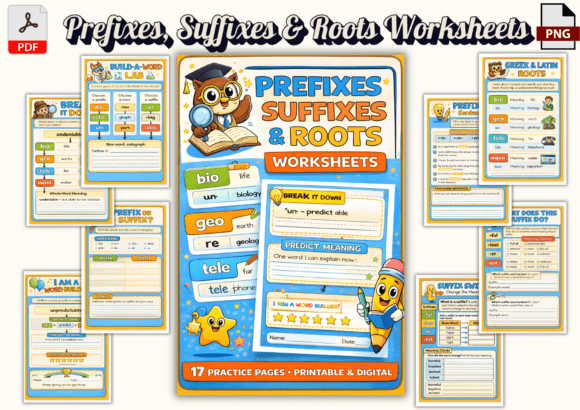
Prefixes, Suffixes Roots Worksheets
In the landscape of educational resource management and curriculum planning, finding tools that offer immediate utility while ensuring long-term scalability is a constant challenge. Prefixes, Suffixes Roots Worksheets represent more than just a collection of practice pages; they are a structured asset designed to integrate seamlessly into diverse learning workflows. Whether you are an educator managing a literacy block, a homeschool parent curating a weekly schedule, or a tutor preparing for intervention sessions, this resource provides a systematic approach to building vocabulary foundations. The bundle's design philosophy centers on morphology—the study of word formation—which serves as a critical cognitive bridge between decoding text and achieving deep reading comprehension.
Strategic Integration into Learning Workflows
The true value of Prefixes, Suffixes Roots Worksheets lies in their flexibility within a broader instructional process. Unlike static handouts that require rigid adherence, these materials function as modular components that can be deployed before, during, or after specific learning activities. For instance, in a classroom setting, these worksheets serve as an effective pre-assessment tool. By introducing Greek and Latin root exploration at the start of a unit, educators can gauge students' existing morphological awareness and identify gaps in their understanding of complex terminology.
During the execution phase of a lesson, the 17 structured practice pages act as scaffolding mechanisms. They allow students to move from passive recognition to active application. The inclusion of sentence construction tasks ensures that the abstract concepts of prefixes and suffixes are grounded in practical context. This aligns with the principle of contextual clue application, where learners must use the surrounding text to verify the meaning derived from word parts. For tutors working with small groups, the digital format allows for rapid customization. Teachers can print specific sections relevant to a student's current struggle, such as suffix meaning practice, without wasting time navigating through irrelevant content.
Preparation and Compatibility Considerations
When integrating any digital resource into a workflow, preparation and compatibility are paramount. Prefixes, Suffixes Roots Worksheets addresses these logistical hurdles through its versatile file delivery. The bundle includes high-resolution PNG files alongside a print-ready PDF version, ensuring that the visual quality remains intact regardless of the output method. The 6x9 inch vertical format is particularly strategic; it mimics standard notebook dimensions, making it easy to organize within binders or folders without requiring specialized binding equipment.
This standardization simplifies the distribution process. Educators can easily upload the PDF to Learning Management Systems (LMS) like Google Classroom or Canvas, while parents can print the pages directly from home using standard office printers. The bright, student-friendly design reduces cognitive load, allowing the learner to focus on the linguistic content rather than deciphering a cluttered layout. Furthermore, the instant download capability supports agile planning. There is no need to wait for shipping or manage inventory; the resource is available immediately when a sudden need for literacy center activities arises.
Operationalizing Morphology Skills
The core objective of this bundle is to develop morphology skills step-by-step. In a professional or academic context, breaking down complex words is akin to decomposing a problem into manageable variables. The worksheets guide students through this decomposition process using word breakdown flowcharts. These visual aids are essential for maintaining consistency in how students approach new vocabulary. Instead of memorizing definitions in isolation, learners analyze the structural components: the prefix that modifies direction or quantity, the root that carries the core meaning, and the suffix that indicates part of speech or tense.
The progression from identification to critical thinking challenges mirrors a mature workflow. Initially, students engage in simple prefix identification activities. As they advance, they tackle reflection confidence builder pages that encourage metacognition—thinking about their own thinking. This shift is crucial for developing academic word confidence. When a student understands the "why" behind a word's structure, they are less likely to feel intimidated by dense academic texts. This skill set is transferable across disciplines, from science and history to literature and mathematics.
- Morphology Awareness: Developing the ability to recognize patterns across different languages and subjects.
- Vocabulary Expansion: Accelerating the acquisition of new terms through structural analysis rather than rote memorization.
- Word Analysis Strategies: Equipping learners with a toolkit to decode unfamiliar words independently.
- Sentence Construction: Applying morphological knowledge to write clearer, more precise sentences.
- Reading Comprehension: Improving overall understanding by grasping the nuances of complex vocabulary.
- Context Clue Application: Using word parts to infer meaning when direct definitions are unavailable.
Quality Control and Long-Term Utility
In any project management scenario, the longevity and reliability of the assets used are critical factors. The Prefixes, Suffixes Roots Worksheets bundle is designed for repeated use and durability. With 17 distinct pages covering various aspects of morphology, the resource offers sufficient volume to support a semester-long intervention program or a year-round homeschool curriculum. The inclusion of Greek and Latin root exploration ensures that the content remains relevant as students encounter increasingly sophisticated language in upper primary and middle school grades.
Quality control is evident in the structured nature of the activities. Each page targets a specific skill, preventing the common issue of disjointed instruction. The logical flow from basic identification to advanced sentence application ensures that students build competence progressively. This systematic approach minimizes the risk of confusion and maximizes retention. For professionals managing multiple students or clients, this consistency is invaluable. It allows for predictable outcomes and easier tracking of progress over time.
Adapting to Diverse Educational Environments
The versatility of this resource makes it suitable for a wide array of environments, each with its own unique constraints and goals. In a traditional classroom, these worksheets can anchor literacy centres, providing independent work options that free up the teacher to focus on targeted interventions. For homeschoolers, the printable nature allows for flexible scheduling. Parents can incorporate a single page into a morning routine or assign a full section as a weekend reinforcement activity.
Tutoring sessions benefit significantly from the digital format. Tutors can quickly adapt the material to meet the specific needs of a client, printing only the necessary pages for a one-on-one session. The reflection confidence builder page is particularly useful here, serving as a checkpoint for students to assess their own growth. This self-assessment component fosters ownership of learning, a key outcome in modern educational frameworks. By engaging with the material actively, students transition from passive recipients of information to active constructors of knowledge.
The integration of critical thinking challenges further elevates the resource beyond simple drill-and-practice. These activities require students to apply their knowledge in novel situations, testing their ability to generalize rules. This higher-order thinking is essential for academic success and prepares students for standardized tests that often rely on context-based vocabulary questions. The emphasis on context clue application ensures that students can navigate real-world reading scenarios where dictionary definitions are not always accessible.
Implementation Tips for Maximum Impact
To get the most out of Prefixes, Suffixes Roots Worksheets, consider the following implementation strategies. First, introduce the concept of morphology early in the learning cycle. Use the word breakdown flowcharts as a visual reference point throughout the term, encouraging students to refer back to them whenever they encounter an unfamiliar word. Second, vary the usage of the 17 pages. Do not treat them as a linear checklist; instead, rotate through them based on the specific vocabulary themes being studied in class or at home.
Third, leverage the digital format for differentiation. If a student struggles with suffixes but excels at roots, provide additional practice on suffix meaning while allowing them to skip ahead on root exploration. Finally, utilize the reflection pages to facilitate discussions. Ask students to explain their reasoning for identifying a particular prefix or root. This verbal articulation reinforces the neural pathways associated with the skill, leading to deeper retention. By treating these worksheets as dynamic tools rather than static assignments, educators and parents can unlock their full potential in supporting vocabulary development.