Digital Product Research Toolkit: A Practical Guide to Validating Ideas Before You Build
In the current landscape of digital entrepreneurship, the gap between a creative idea and a profitable product is often bridged by rigorous market research. Many creators, from Etsy sellers to KDP publishers, fail not because their designs lack quality, but because they launch into saturated markets without validating demand. The Digital Product Research Toolkit addresses this critical bottleneck by providing a structured approach to identifying opportunities before time and capital are invested.
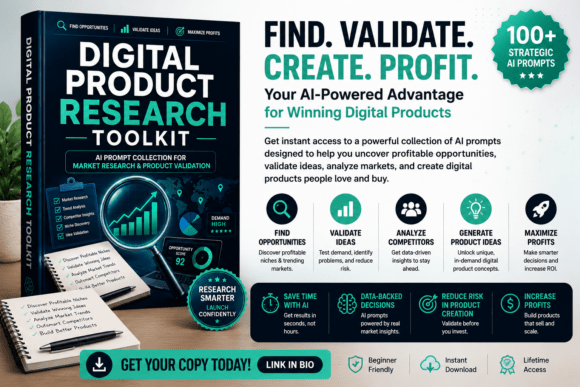
This resource is not merely a list of generic questions; it is a curated collection of AI prompts designed to simulate the workflow of a seasoned market analyst. By leveraging artificial intelligence for data synthesis, users can navigate complex market dynamics with greater efficiency. The toolkit includes specific modules for trend analysis, customer profiling, and competitor benchmarking, all formatted for immediate use in popular AI interfaces.
Bridging the Gap Between Intuition and Data
The primary value proposition of the Digital Product Research Toolkit lies in its ability to transform vague instincts into actionable data points. Historically, deep market research required expensive subscriptions to analytics platforms or hours of manual spreadsheet work. This toolkit democratizes that access by utilizing natural language processing to extract insights from broad datasets.
When evaluating the utility of such a resource, one must consider the typical pain points faced by digital creators. These often include:
- Ideation Fatigue: Running out of fresh concepts that haven't already been overexplored.
- Validation Anxiety: The fear of investing weeks in a design only to find zero sales traction.
- Competitive Blindness: Underestimating the saturation of a niche due to a lack of systematic competitor analysis.
The toolkit mitigates these risks by forcing the user to articulate specific constraints and criteria before generating any output. Instead of asking an AI "What should I sell?", the prompts guide the user to ask "What underserved sub-niche within home decor has rising search volume but low competition?" This shift in questioning strategy is where the true power of the Digital Product Research Toolkit resides.
Core Components and Structural Integrity
The collection is organized into logical categories that mirror the standard product development lifecycle. Each section serves a distinct purpose in filtering viable ideas from dead ends.
- Trend Analysis Prompts: These are designed to scan broader cultural and seasonal shifts. They help identify emerging keywords and topics before they hit mainstream saturation. For a creator on Creative Fabrica, this might mean spotting a specific aesthetic movement early enough to capitalize on the initial wave.
- Market Validation Prompts: Once a potential idea is identified, these prompts assist in stress-testing it. They encourage the simulation of customer objections, price sensitivity analysis, and feature prioritization.
- Customer Research Prompts: Understanding the buyer persona is crucial. This section helps generate detailed profiles, including pain points, purchasing behaviors, and language patterns used by the target demographic.
- Competitor Analysis Prompts: Rather than simply listing competitors, these prompts guide the user to analyze gaps in competitor offerings. What features are missing? Where are the reviews complaining about poor quality? These gaps represent opportunities.
The inclusion of a Premium Layout in the PDF format ensures that the prompts are easy to reference during active work sessions. The visual organization reduces cognitive load, allowing the user to focus on the strategic thinking rather than formatting issues.
Real-World Application and Usability
To understand the practical effectiveness of the Digital Product Research Toolkit, it is helpful to examine how it functions within different workflows. The tool is agnostic to the specific platform, making it versatile for various digital business models.
Consider a Gumroad Creator planning to launch a set of productivity templates. Without the toolkit, they might rely on gut feeling or superficial keyword searches. By applying the Digital Product Research Toolkit, they could use the Competitor Analysis prompts to discover that while many planners exist, few address the specific needs of remote team managers. The Customer Research prompts would then help them draft survey questions to validate if this specific group is willing to pay a premium for that specialized functionality.
Similarly, a KDP Publisher dealing with non-fiction books can use the Trend Analysis section to avoid writing about topics that have already peaked. They can instead pivot to a related angle that shows upward momentum. The consistency of the prompts ensures that the AI provides structured, comparable answers across different niches, which is essential for building a reliable product roadmap.
Usability is further enhanced by the clarity of the instructions. The prompts are written to be "plug-and-play," requiring minimal technical knowledge to execute effectively. However, the quality of the output remains dependent on the input. As with any AI-driven process, the user must provide context. The toolkit assumes the role of a sophisticated assistant, but the human operator remains the strategist.
Strengths in Flexibility and Adaptability
One of the standout features of this collection is its adaptability. Digital markets evolve rapidly, and static strategies often become obsolete. The prompts within the Digital Product Research Toolkit are framed in a way that allows for iterative refinement. If a prompt yields a result that seems too broad, the user can immediately refine the parameters based on the previous output.
This flexibility supports long-term value. A creator does not just use the toolkit once to find a single product; they can integrate it into their quarterly planning cycle. It becomes a recurring asset for maintaining a pipeline of relevant, high-potential projects. The emphasis on finding underserved markets aligns well with the current economic climate, where differentiation is often more valuable than competing on price alone.
Evaluating Limitations and Strategic Fit
While the Digital Product Research Toolkit offers significant advantages, a balanced evaluation requires acknowledging its limitations. AI models, while powerful, operate on training data that may have a latency period. This means that extremely real-time trends (those occurring in the last 24 hours) might not be fully reflected in the initial outputs. Users must supplement the toolkit's findings with live social media monitoring or direct community engagement.
Furthermore, the tool generates hypotheses, not absolute truths. It excels at pattern recognition and suggestion, but it cannot replace the final validation step of actual market testing. For instance, an AI might suggest a specific book title based on current bestseller lists, but it cannot guarantee that a new reader will connect with the content. Therefore, the toolkit should be viewed as a high-efficiency filter for ideation, not a crystal ball for sales forecasting.
For professionals who prefer manual data entry and traditional spreadsheets, there may be a learning curve associated with integrating AI prompts into their existing workflow. However, the time saved in synthesizing information usually outweighs the initial adjustment period. The toolkit is particularly beneficial for solo entrepreneurs or small teams who lack dedicated research departments.
Who Benefits Most from This Resource?
The Digital Product Research Toolkit is most effective for individuals and small businesses operating in competitive digital spaces. The following groups will likely derive the highest return on investment:
- Etsy Sellers: Who need to constantly refresh their inventory to stay visible in a crowded marketplace.
- Creative Fabrica Designers: Who require a steady stream of unique assets that stand out against mass-produced alternatives.
- KDP Publishers: Who face high rejection rates and need to ensure their book concepts align with proven reader interests.
- Digital Entrepreneurs: Who are launching courses, software, or membership sites and need to validate the problem-solution fit before development.
It is less suitable for those seeking a "get rich quick" solution or those unwilling to engage in the critical thinking required to interpret AI outputs. The tool amplifies the user's capabilities; it does not replace the need for strategic judgment.
Final Thoughts on Strategic Implementation
The transition from guessing to knowing is the defining characteristic of successful digital product launches. The Digital Product Research Toolkit provides a structured, professional framework for making that transition. By combining the speed of AI with the depth of market research principles, it offers a compelling alternative to traditional, slower methods of validation.
Whether you are looking to generate profitable concepts or build a comprehensive product roadmap, this collection serves as a robust foundation. Its strength lies in its practical application and its ability to streamline the often tedious process of market analysis. For creators serious about minimizing risk and maximizing the potential of their next venture, incorporating this toolkit into their workflow represents a logical and effective step forward.
Ultimately, the decision to adopt this resource depends on your willingness to embrace data-driven creativity. In an environment where attention is scarce and competition is fierce, the ability to accurately identify what customers actually want—before you build it—is a decisive competitive advantage. The Digital Product Research Toolkit equips you with the prompts necessary to secure that advantage.